
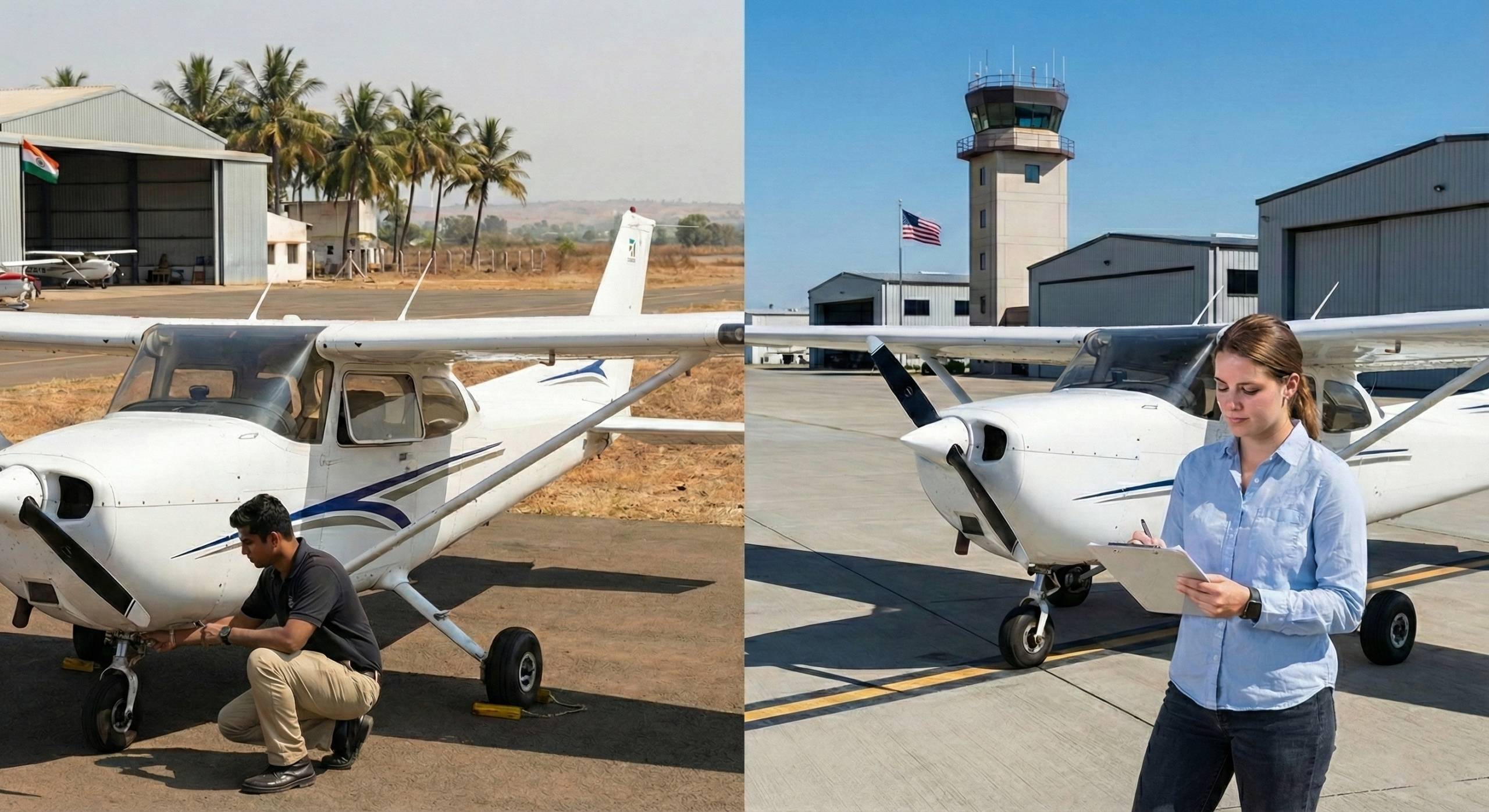
 For every aspiring aviator, the journey begins with a single, critical question: “Where should I train?”
While the destination the captain’s seat of a commercial airliner remains the same, the path to getting there varies significantly depending on geography. The debate of pilot training India vs USA is a common topic at dinner tables and career counseling sessions. Both countries offer robust aviation sectors, but the training environments, opportunities, and long-term career trajectories differ fundamentally.
At World Wide Wings, we believe in empowering students with facts. Choosing a flight school is not just about picking a location; it is about choosing the launchpad for your entire career. To help you weigh your options, we have broken down the comparison into four critical factors: Technology, Cost, Time, and Recognition.
Factor 1: Training Standards, Technology, and Airspace
The quality of a pilot is often a reflection of the environment in which they trained.
The United States Advantage
The USA is widely regarded as the cradle of aviation. Training here means learning in some of the most complex and diverse airspaces in the world.
- Infrastructure: The US General Aviation infrastructure is unmatched. With thousands of public airports, students are not limited to a single runway.
- Airspace Complexity: Flying in the US exposes students to busy air traffic control environments from day one. Our students, for instance, train near major international hubs, sharing the sky with heavy cargo jets and commercial airliners. This exposure builds a level of situational awareness and radio confidence that is hard to replicate elsewhere.
- Technology: US flight schools typically operate modern fleets equipped with “glass cockpits” (digital avionics). Training on the latest technology ensures seamless transition to modern airline jets.
The Indian Scenario
India has made great strides in aviation training, but infrastructure challenges remain.
- Airspace Restrictions: Much of the Indian airspace is reserved for military use or restricted, limiting the “free flight” experience for students.
- Traffic Density: While major airports are busy, training airports in remote locations often lack the complex traffic density needed to sharpen a student’s reflexes and decision-making skills early on.
Factor 2: Cost and Return on Investment (ROI)
When families discuss flight school India versus the USA, the conversation almost always turns to cost. On paper, the raw tuition fees might look comparable, or one might seem slightly lower. However, the true metric is the Net Cost and the Return on Investment (ROI).
The “Learn & Earn” Difference
In the United States, regulations allow for a unique career progression that significantly impacts ROI.
- Earning While Training: At World Wide Wings, we champion the “Learn & Earn” model. After completing their initial commercial ratings, students can obtain their Certified Flight Instructor (CFI) ratings. This allows them to work as paid professionals within the flight school ecosystem.
- Offsetting Costs: By earning a professional income during the latter stages of their stay in the US, students can offset a portion of their living and training expenses.
The Traditional Indian Model
In India, the pathway is typically linear and expenditure-heavy.
- Pay and Wait: Students pay for their CPL training and then must seek airline employment immediately. There is rarely an intermediate “earning phase” during training.
- Type Rating Costs: Often, after getting a license in India, students must pay substantial additional amounts for “Type Ratings” (training on specific jets like the A320 or B737) before they are employable, increasing the total financial burden.
Factor 3: Time to Completion
Time is money. The longer you spend in training, the longer you delay your first airline paycheck.
Weather and Efficiency in the USA
Geography plays a massive role in flight training.
- Flyable Days: Our campuses in California and Florida are strategically located in regions known for year-round sunshine. This allows for consistent, uninterrupted training schedules.
- Aircraft Availability: With a large general aviation fleet and robust maintenance support (like our in-house MRO teams), aircraft downtime is minimized. Students can fly frequently, building muscle memory and finishing their ratings on an accelerated timeline.
Weather Challenges in India
- Monsoon Delays: The Indian monsoon season can ground small training aircraft for weeks or even months at a time.
- Operational Delays: Bureaucracy and operational constraints at smaller airfields can often lead to gaps in training. A course that might take a short period in the US can drag on significantly longer in India due to these external factors.
Factor 4: Global Recognition and Career Mobility
A pilot license is your passport to the world, but not all passports carry the same weight.
The Power of the FAA License
The Federal Aviation Administration (FAA) sets the global gold standard for aviation safety.
- Worldwide Acceptance: An FAA CPL is recognized globally. It is relatively easy to convert an FAA license to the equivalent license in almost any other country.
- The Degree Advantage: Many US programs, including ours, integrate a Bachelor of Science in Aeronautics from a prestigious US university. This combination of a globally respected license and a STEM degree opens doors to international carriers in the Middle East and Asia that often prefer Western-trained pilots.
The DGCA License
- Regional Focus: A DGCA license is excellent for flying within India. However, if you wish to work for international airlines abroad later in your career, you may face a rigorous and lengthy conversion process to validate your Indian license in other jurisdictions.
Conclusion: The Competitive Edge
While it is certainly possible to become a skilled pilot in India, the United States offers a training ecosystem designed for speed, proficiency, and global career mobility.
When you factor in the ability to train in complex airspace, the efficiency of weather-friendly locations, and the financial advantages of the “Learn & Earn” model, the US pathway offers a superior Return on Investment.
Here is a quick summary of why the US route stands out:
| Feature | Pilot Training in India | Pilot Training in USA (World Wide Wings) |
| Airspace Exposure | Limited / Regional | Complex / International Traffic |
| Training Duration | Often delayed by weather/ops | Accelerated due to weather/fleet |
| Earning Opportunity | Minimal during training | High (Learn & Earn / CFI) |
| Global Mobility | Difficult to convert abroad | Gold Standard (FAA) / High Mobility |
| Degree Integration | Usually separate | Integrated B.S. Aeronautics |
At World Wide Wings, we provide the bridge to this global opportunity, ensuring you don’t just get a license, but a career.
[Explore Our Global Pilot Programs Today]